

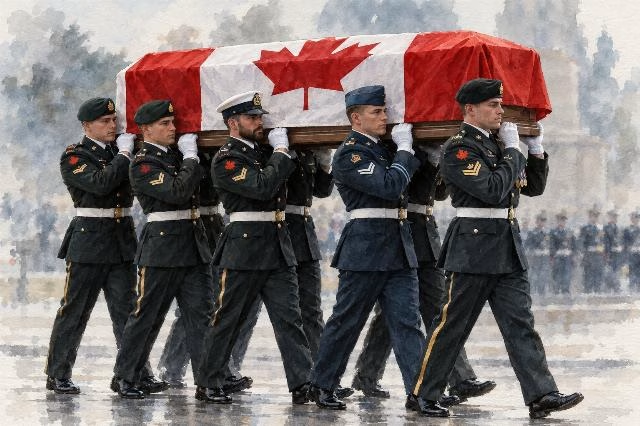
Four Soldiers Died Because The Military Knew The Risks And Continued Anyway
by
An avoidable tragedy in Canada means the U.S. should be reevaluating the competence of the nation’s military leadership.
Four Canadian soldiers are dead because the chain of command at CFB Wainwright decided that a known grass fire, extreme fire danger, and forecasted high winds were acceptable conditions for live-fire training. Thirty-nine more were injured, nineteen of them critically. The fire started on an automatic grenade launcher range. It had been burning for hours. Then, driven by the wind, it jumped nearly a kilometer in under a minute. The troops were preparing for a NATO deployment to Latvia. This was not an act of God. It was a decision made by people who chose to ignore the risks.
The sequence is straightforward. A grass fire was detected on the range in the early afternoon. Fire danger in the area was already extreme. Environment Canada had issued wind warnings forecasting gusts of 80 kph or higher; later measurements at the base recorded stronger gusts. Firefighters could not enter the permanent danger area because of unexploded ordnance. Range control procedures, weather briefings, and stop-training criteria exist for exactly these conditions. The military knew a fire was already burning on the live-fire range. It knew the fire danger rating. It knew the wind forecast. It nevertheless carried out the training.
When the wind shifted, the fire became a wall of flame. Sgt. Morgan Wong, Pte. Shaun Farrell, Pte. Aidan Goulding, and Pte. Hayden Lykkemark did not survive. Byran Farrell, brother of Pte. Shaun Farrell, told the Toronto Star through tears that he did not understand why more safety precautions were not taken amid the forecasted high winds and a fire burning nearby. “They died for nothing,” he said. The question is not complicated. Why was the exercise still running when those conditions were already known?
Other families have spoken more in the language of grief than of accusation. Sgt. Wong’s family said they were “shocked and deeply saddened” and described him as someone who was “always there whenever anyone needed him.” Sonia Monk, mother of Pte. Aidan Goulding, told CBC’s As It Happens that her heart “just dropped” when she learned of the fire. Her son had quit a steady job as a mechanic because he felt he had one life to live and wanted to protect his country. Nadine Dunford, foster mother of Pte. Hayden Lykkemark, spoke of the unfairness of losing a young man who had chosen service. These accounts do not replace the operational record. They show what the decision to continue actually cost.
This was not an unforeseeable natural disaster. Military training ranges are built with permanent danger areas precisely because of the risks of munitions and fire. The tools to recognize elevated risk and to stop training were already in place. Using them was the basic requirement. Continuing under known, elevated risks is the kind of decision that those procedures exist to prevent. The fact that the exercise went ahead raises direct questions about what the chain of command knew, when it knew it, and why the range was not cleared or the training relocated while there was still time.
full story at https://www.americanthinker.com/articles/2026/10/four-soldiers-died-because-the-military-knew-the-risks-and-continued-anyway/
Categorised in: Canadian News