

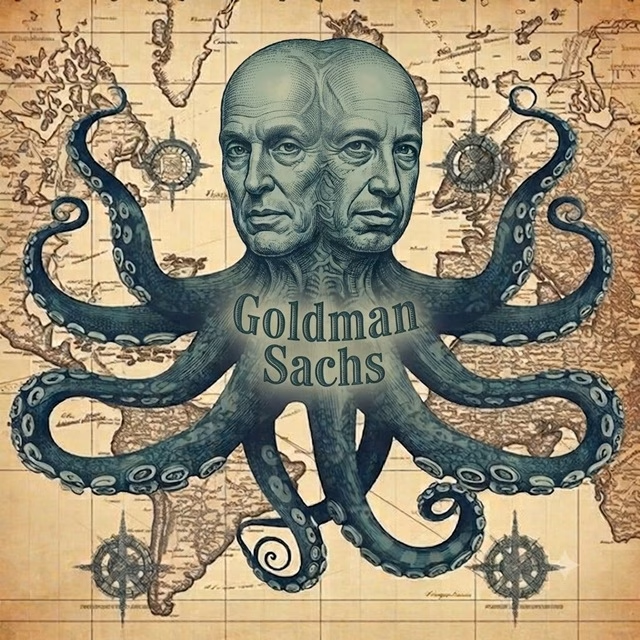
The Role of Goldman Sachs in Engineering Global Financial Crises
by
How Goldman Sachs is Behind the Takeover of National Infrastructure and Banking in its Bid for Global Domination
This is Part II of the series The True Origins of China’s ‘Social Credit System.’
The True Origins of China’s “Social Credit System” Part I
Free-markets, Deregulation and “The Largest Bank Heist in History”
The global economic crash of 2008 cost tens of millions of people their savings, their jobs and their homes. The government regulators who should’ve been protecting the citizens had done nothing.
The result of Lehman Brothers and AIG collapsing was a global recession. Costing the world tens of trillions of dollars and rendered 30 million people unemployed globally.[1]
It also doubled the national debt of the United States.

As we can see in the above graph, the rapid increase in U.S. debt begins in the 1980s at the onset of deregulation and is accelerated dramatically after the 2008 crash.
In the 1980s the financial industry exploded. The investment banks went public giving them huge amounts of stockholder money. In the traditional investment banking model, the one that had been operating for over a century before, the partners put the money up and thus, would obviously watch their money very carefully.
One of the moral hazards that began to creep up with these investment banks going public was that the decisions that the CEO and partners of these firms were making were now involving massive amounts of money that were not their own and that was not being watched very carefully at all. In other words, major investment firms like Lehman Brothers (f. 1850), Merrill Lynch (f. 1914), Goldman Sachs (f. 1869), Bear Stearns (f. 1923) and Morgan Stanley (f. 1935) were making decisions on risk that would no longer affect the salaries (and bonuses) of their CEO, partners and managers.
The 1980s were full of cut-throat dealings in mergers and acquisitions. Increasingly there was nothing that could protect small and medium-sized enterprises (SMEs)[2] if a much larger one wished to purchase (or “acquire”) them, and often with not even the desire to see the company expand and further succeed. Many of the acquisitions made during this period involved the actual scrapping of these companies into pieces sold off to the highest bidders, the workers laid-off after decades of working for a company that had at one time dedicated itself to a high-standard of quality in what they were manufacturing or providing as a service, such as airlines.
Ironically, in the increasingly “free-market” world of the 1980s and on, which people were told was a good thing because it would increase competition and thus promote the best and most excellent, the opposite was true. In truth, “free-market” meant the rule of the most powerful and influential. Larger companies and institutions purchased their competitors and scrapped them into pieces. Excellence if you were small now often sealed the end of the road, at best your company would be bought for a generous sum and continued under their massive rubric, at worse it would be purchased for pennies and eviscerated. The only thing certain was that you were not free to see your company through past a certain point of success under solely your own helm.
This new world of finance was made possible by the joint initiative of the Reagan Administration and Margaret Thatcher’s cabinet in the UK.
In 1981 President Ronald Reagan (1981-1989) chose as his Treasury of Secretary the CEO of the investment bank Merrill Lynch, Donald Regan (1981-1985). Regan had served as the CEO of Merrill Lynch for nearly ten years, from 1971 to 1980, before accepting the position of U.S. Treasury Secretary. It was Donald Regan[3] who promoted a new financial system that would be coined “Reagonomics.” Its critics and opponents called it “trickle-down economics” or “voodoo economics,” Reagan and his advocates preferred to call it “free-market economics.”
Whatever you want to call it – it started a 30-year period of radical financial deregulation.
In 1982 the Reagan Administration (or perhaps more aptly called the Regan Administration) deregulated savings-and-loan companies allowing them to make risky investments with depositors’ money. By the end of the decade hundreds of savings-and-loan companies had failed. This crisis cost taxpayers $124 billion and cost many people their life savings.[4]
As NBC News anchor Tom Brokaw famously stated: “It may be the biggest bank heist in our history.” referring to the savings and loan (S&L) fraud. And I think that is a pretty accurate statement, however, it pales in comparison to what would occur in 2008 as we will soon see.

“It may be the biggest bank heist in our history.” referring to the savings and loan fraud. Tom Brokaw NBC News. Clip from Inside Job (2010) Documentary.
However, unlike 2008, thousands of savings and loans executives actually went to jail for looting their companies. One of the most extreme cases was Charles Keating who ran the American Continental Corporation and the Lincoln Savings and Loan Association.
The 2010 documentary Inside Job, discusses how in 1985 when federal regulators began investigating him, Keating hired Alan Greenspan. This was two years before Greenspan would become Chairman of the Federal Reserve in 1987. Before this he had worked as an economic adviser for the Ford Administration and Nixon Administration, as well as the President of the Council on Foreign Relations from 1982 to 1988. In a letter to regulators, Greenspan praised Keating’s sound business plans and expertise and said he saw no risk in allowing Keating to invest customer’s money. Keating reportedly paid Greenspan $40,000.[5]
Keating went to prison shortly afterwards, convicted in both federal and state courts of many counts of fraud, racketeering and conspiracy. When Lincoln S&L Association failed in 1989 it cost the federal government over $3 billion and about 23,000 customers were left with worthless bonds.[6]
Alan Greenspan for his sound advice on Keating to regulators, one of the worse cases of fraud during the S&L debacle, was promoted to Chairman of the Federal Reserve by President Reagan. He was reappointed this position under President Clinton and George W. Bush, serving as Chairman of the Federal Reserve from 1987-2006, a total of over 18 years. Greenspan was the second longest serving chairman in the history of the Federal Reserve, missing first place by just a few months.[7]
Deregulation opened the doors to financial instability rather than stability, and the 1980s and 1990s resulted in the failure of about a third of U.S. savings and loan institutions, costing taxpayers $124 billion.
This American crusade for free-markets was happening in lock-step with the British crusade for the very same thing.
The UK under British Prime Minister Margaret Thatcher (1979-1990) came to be known as the era of “Thatcherism” where she and her Administration championed radical free-market reform, deregulation and neoliberal policies resulting in widespread privatization.
Both Reagan and Thatcher promoted minimal government intervention in the economy and strict control over public spending aiming to reduce the role of the state in the economy and they began to sell state-owned industries including telecommunications, utilities, transportation, energy etc. to private companies.
In fact, Thatcher’s government had specifically brought in Goldman Sachs to oversee the selling-off of these state-owned companies as an official adviser to the British Government in the 1980s.
In their own fluff piece documentary of themselves, Goldman Sachs at 150,[8] they describe how “the beginning of deregulation was the beginning of globalisation.” And how the deregulation policies of both Thatcher and Reagan allowed Goldman Sachs out of the cage effectively.
With these new wings of flight, Goldman Sachs began to work closely with the British Government and the City of London in the privatizations of great nationalised entities as an official advisor.[9] According to Goldman Sachs’ own biography, they handled every single one of these cases in the UK except for one.[10]
They then went on, in their own words into Germany to do the very same thing, then Scandinavia, then France, then Italy and pretty much everywhere else and as they put it “revolutionized finance in all of Europe.”[11]
Thus, according to Goldman Sachs themselves, they oversaw the privatization of finance in pretty much all of Europe, beginning first in the UK.
According to Goldman Sachs this liberated these previously state-owned entities to fully participate in the financial markets.
During the Clinton Administration deregulation continued under Alan Greenspan as Chairman of the Federal Reserve and Treasury Secretaries Robert Rubin (1995-1999), former chairman of Goldman Sachs and Treasury Secretary Larry Summers (1999-2001), later becoming the President of Harvard from 2001-2006. Robert Rubin is recognised as the long-time mentor of Larry Summers.[12]
According to the documentary Inside Job (2010):
By the late 1990s the financial sector had consolidated into a few gigantic firms, each of them so large that their failure could threaten the whole system.
In 1998 Citicorp and Travelers merged to form Citigroup the largest financial services company in the world. The merger violated the Glass-Steagall Act,[13] a law passed after the Great Depression preventing banks with consumer deposits from engaging in risky investment-banking activities.
It was illegal to acquire Travelers. Greenspan said nothing. The Federal Reserve gave them an exemption for a year and then they got the law passed.
In 1999 at the urging of Summers and Rubin, Congress passed the Gramm-Leach-Bliley Act known to some as the Citigroup Relief Act. It overturned Glass-Steagall and cleared the way for future mergers.
Robert Rubin would later make $126 million as Vice Chairman of Citigroup.
The next crisis came at the end of the 1990s. The investment banks fueled a massive bubble in internet stocks which was followed by a crash in 2001 that caused $5 trillion in investment losses.
The Securities and Exchange Commission [SEC], the federal agency that had been created during the Depression to regulate investment banking, had done nothing.
These investment banks had promoted internet companies they knew would fail, which sounds awfully similar to the present financial crisis brewing. Stock analysts were paid by how much business they brought in. In December 2002, ten investment banks settled the case for a total of $1.4 billion and promised to change their ways. Despite the hefty fines, they did not have to admit to any wrongdoing.
These ten investment banks which had caused $5 trillion in investment losses, paid a $1.4 billion fine in total spread out amongst themselves.
full story at https://www.activistpost.com/the-role-of-goldman-sachs-in-engineering-global-financial-crises/
Categorised in: Canadian News